
by Enrico Maria Davoli
The exhibition Carlo Maria Mariani. L'eternità della pittura, curated by Eike Schmidt and Clayton Calvert, is on view from October 9, 2026, to January 10, 2027, at Palazzo Citterio in Milan. The catalog, featuring essays by Clayton Calvert, Laura Cherubini, Angelo Crespi, Roberta Minnucci, Francesca Sborgi, Eike Schmidt, Vittorio Sgarbi, and Sara Taglialapietra, is published by Mœbius, Milan.
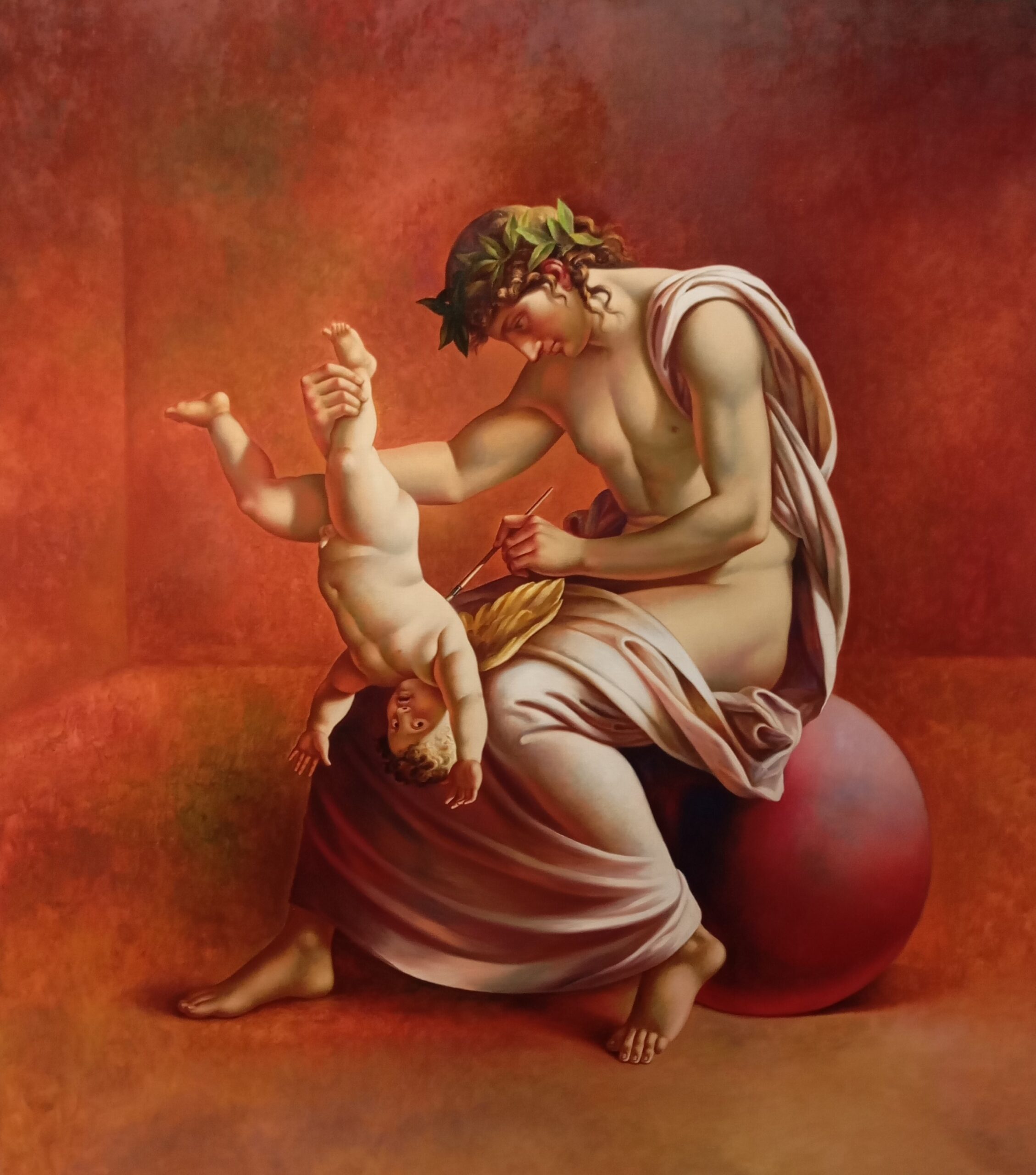
This Milanese retrospective of Carlo Maria Mariani (1931–2021) follows the less ambitious exhibitions held two years ago in Florence, Palazzo Pitti, and in recent months in Naples, Capodimonte Museum. Through some seventy works, it traces the artist’s entire career. Or rather, almost his entire career, given that Mariani was not only a painter of secular subjects but, in his youth, also earned a living in the field of sacred art, as a creator of altarpieces and frescoes – that is, as a decorator in the most classical sense of the term. Sacred art is a chapter about which he himself remained silent, but one that would not be out of place as a preamble to his official body of work.
With his paintings – which always hover ironically between myth and history, Renaissance-modern humanism and contemporary nihilism – Mariani came to be recognized around 1980 as the guiding figure behind movements such as “Anacronismo”, “Pittura Colta”, and “Ipermanierismo”. But beyond the influence he exerted on a host of artists much younger than himself, the fact remains that, by the time international fame began to smile upon him, he already had a long career behind him. In fact, as early as the 1960s, when no one was yet talking about revivalism, memory, or a return to the craft, Mariani was already traveling that path, and to do so, all he had to do was remain faithful to what he considered the medium par excellence: painting.
It must also be said – and this exhibition highlights this point effectively – that the egocentrism and narcissism characteristic of postmodern art have very little place in Mariani’s artistic vision. His is a refined artistic language, in which everything, from the thematic repertoire to the most minute details rendered by pencil and brush, responds to a timeless vision that stretches from Pompeian art to Raphael, Mengs, and David, and then engages with figures of the neo-avant-garde who, in the meantime, have abandoned painting, such as Giulio Paolini and Claudio Parmiggiani. Mariani’s style, in its classical impersonality, is archetypal, capable of evoking profound wonder. For him, citationism is not a program but a mindset similar to that which animated the masters of the past, for whom engagement with tradition was inherent in being an artist. Thus, the humor with which Mariani references Duchamp’s Bottle Rack and other avant-garde clichés stems from the fact that, once brought back into painting, even these devices – which on paper seem intractable – are brought back into play, in a dialogue across time that reflects a historical conception that is not progressive but circular.
Aware of this, Mariani was able to indulge in flights of fancy that the art of the second half of the 20th century, with its tendency toward minimalism, had by then grown unaccustomed to. For example, painting a full-length self-portrait of himself lying on the floor next to the weathered slab of a medieval tomb, as if to let those centuries and that constant flow of visitors pass over him as well. Or indulging in the whim of repainting a lost painting by Jacques-Louis David, The Death of Lepelletier de Saint-Fargeau, just as Botticelli had done in his time with The Calumny of the Greek painter Apelles. Or still, as an excellent art critic, to grasp the similarity between the female allegory in Ingres’s The Source and a figure from Picasso’s Les Demoiselles d’Avignon, combining them in the same painting. This exhibition is a collection of enigmas, insights, allusions, and paradoxes that establish Mariani as a unique figure in the visual arts at the turn of the 20th and 21st centuries.
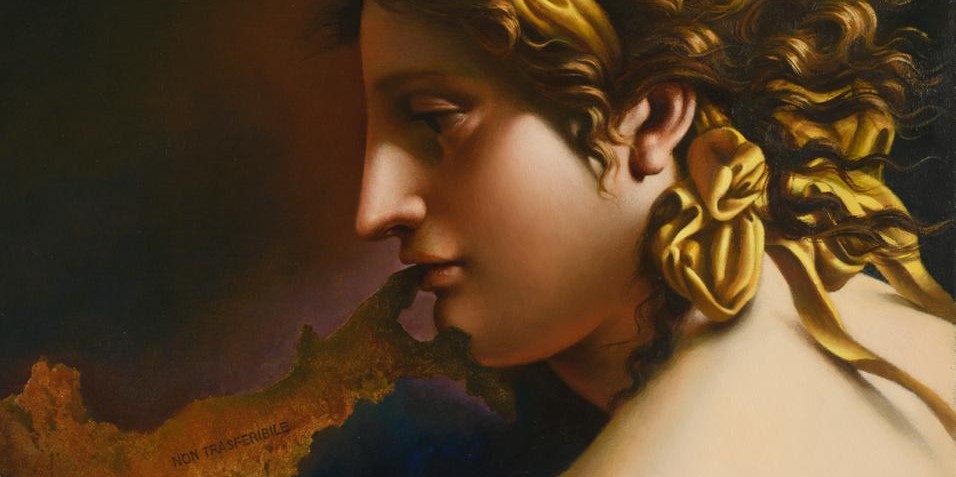
Homepage: Carlo Maria Mariani, Non trasferibile (detail), 1993, oil on canvas, 44 x 41 cm (© SIAE).
Below: Carlo Maria Mariani, The Left Handed Painter, 1982, oil on canvas, 203 x 175 cm (photo credits Enrico Maria Davoli).